 Avalonfinance
 collateral secures Bitcoin-backed loans under product-specific custody and lending rules
- updatedAvalonfinance collateral secures borrowing against Bitcoin (BTC) and related assets, with custody and borrowing limits determined by the lending product. Institutional CeDeFi loans use third-party custody, while on-chain markets apply their own asset and risk parameters. In the documented FBTC CeDeFi configuration, loan-to-value limits govern borrowing, withdrawals, and liquidation. USDa's former collateral-backed issuance belongs to a separate product Avalon Labs announced it would discontinue across all supported chains on October 3, 2026.
Which Bitcoin asset can secure a CeDeFi loan?
FBTC is the collateral asset named in Avalon's CeDeFi borrowing instructions; the institutional offering describes credit backed by Bitcoin held in custody. Bitcoin describes the underlying exposure; the deposit route still specifies the asset accepted as collateral. For an on-chain lending position, the collateral also belongs to a specific network and market.
A collateral balance records the asset securing a debt. The loan proceeds record the asset borrowed against it.
Institutional custody and the secured obligation
Independent custodians hold the Bitcoin backing Avalon's institutional credit offering, while the borrower's repayment obligation remains attached to the loan. This arrangement lets a borrower raise funds without selling the pledged Bitcoin at the outset. Loan terms and risk limits govern how much collateral the borrower can withdraw while debt remains. Market-value changes still affect Bitcoin held by a custodian, and the secured loan retains its liquidation conditions.
LTV limits and the documented FBTC configuration
Loan-to-value, or LTV, compares the borrowed stablecoin's value with the collateral's value, expressed in the same valuation unit. A falling collateral valuation raises LTV if debt stays unchanged.
Separate limits for borrowing and liquidation
Maximum borrowing LTV
The documented FBTC CeDeFi borrowing cap is 60% LTV. This cap governs how much a borrower can request against the collateral. It's separate from the point where a deteriorating loan becomes eligible for liquidation.
Liquidation and recovery LTV
The same configuration lists a 90% liquidation threshold and an 80% recovery LTV. If LTV exceeds that threshold, partial collateral liquidation aims to reduce the ratio toward its recovery target. The recovery target concerns liquidation; the borrowing cap governs new credit.
Other collateral products have their own applicable parameters.
Rates and the debt the collateral secures
CeDeFi borrowing rates combine the funding institution's rate with Avalon's additional service spread, which forms part of the borrower's interest cost. The model fixes borrowing rates instead of tying them to changing pool utilization. The selected CeDeFi loan's terms govern that pricing arrangement.
A fixed borrowing rate concerns debt pricing. Collateral limits concern the value supporting that debt. A borrower needs to distinguish the amount owed, including interest, from the amount of Bitcoin or FBTC pledged. The principal remains a repayment obligation even when the collateral retains its market value.
Does a fixed borrowing rate prevent liquidation?
A fixed borrowing rate doesn't prevent liquidation, because a drop in collateral value can push the loan beyond its permitted risk limits.
Restricted withdrawals during CeDeFi liquidation
CeDeFi's liquidation procedure temporarily blocks collateral withdrawals until liquidation finishes. The process sells collateral on centralized exchanges and updates the account afterward. The updated record reflects changes to both collateral and loan amounts.
Liquidation can reduce both outstanding debt and the collateral remaining in the account. The smaller loan reflects payment funded from pledged assets. Read both updated amounts to understand the post-sale credit position.
Isolated markets and collateral health
DeFi lending organizes Bitcoin liquid-staking derivatives into isolated pools with asset-specific LTV and liquidation settings. Each documented BTC-derivative pool includes the derivative and BTC. Stablecoin inclusion depends on that derivative's on-chain liquidity. The presence of Bitcoin-related collateral therefore doesn't establish an identical set of borrowing assets across every pool.
The DeFi lending rules make a position eligible for liquidation when its health factor falls below 1. A falling collateral valuation or increasing debt can weaken account health. The documented DeFi procedure allows a liquidator to repay up to 50% of debt, with the matching value and liquidation fee coming from collateral. The fee varies by collateral asset; 50% describes the debt repayment limit.
Collateral release and the repayment balance
Full CeDeFi collateral withdrawal requires repayment of the entire obligation, including principal and interest, before the borrower can remove all the backing. A partial withdrawal follows a different constraint: the remaining collateral must keep the loan within LTV requirements. Removing collateral without reducing debt raises the ratio. The permitted withdrawal amount therefore follows from the collateral left behind and the debt it continues to secure.
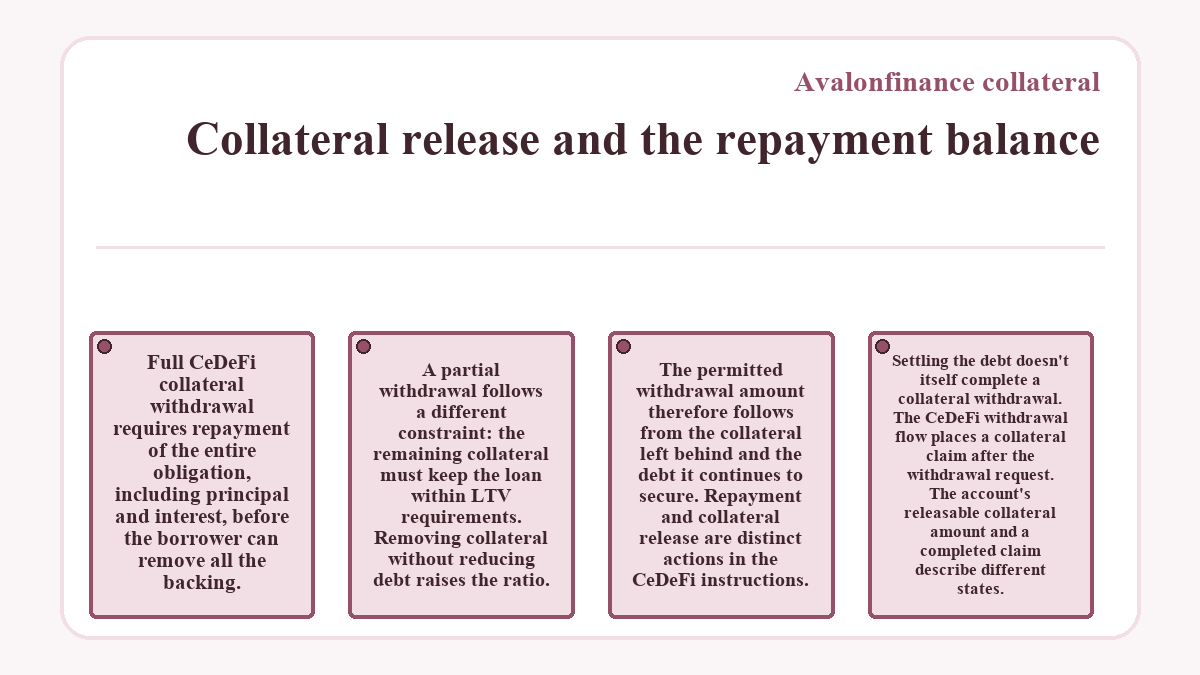
Repayment and collateral release are distinct actions in the CeDeFi instructions. Settling the debt doesn't itself complete a collateral withdrawal.
The CeDeFi withdrawal flow places a collateral claim after the withdrawal request. The account's releasable collateral amount and a completed claim describe different states.
Suspended markets and USDa's former collateral route
Lending-market availability changed for positions on Bitlayer, BSC, Core, BOB, BSquared, and Mode after APRO discontinued oracle price-feed services. Avalon Labs' June 10, 2026 withdrawal tutorial identified those suspensions. The suspension changed lending availability even where a user still held a position. USDa's Bitcoin-backed issuance was a separate collateral route. Avalon Labs announced its discontinuation across all supported chains on October 3, 2026. Older descriptions of minting USDa against Bitcoin belong to that product's earlier operating state. A separate CeDeFi credit position retains its own product terms.
Account checks before borrowing or releasing collateral
Additional borrowing and collateral withdrawal both raise a CeDeFi position's LTV when other inputs stay unchanged. Which action do the account's current collateral and debt support? Additional borrowing raises debt against the existing backing; withdrawal reduces that backing. Repayment changes the comparison by reducing the debt, which can increase the collateral available for release.
- Match the deposit to the accepted collateral asset; if the account lacks eligible collateral, supply it before requesting a loan.
- For another loan request, assess LTV using the total debt after the proposed borrowing against the existing collateral.
- For a partial release, assess LTV using the collateral remaining after withdrawal.
- For full release, reconcile both principal and interest as repaid before requesting all the collateral.
- Check whether liquidation restrictions still block withdrawals, then distinguish a requested release from collateral available to claim.
Reconcile the account's updated collateral and debt before another request. A repayment confirmation supports a lower debt balance; a completed collateral claim supports treating that asset as returned.
Net position value in Zeta Market's announced return
In Important Notice Regarding Recent Asset Adjustments, published October 3, 2026, Avalon Labs described valuing that net position in USD at snapshot time. The corresponding distribution would use USDT on Ethereum. A gross collateral balance alone couldn't establish that settlement amount. An individual payout requires its own completed transfer.
The notice set October 17, 2026 (UTC) as Zeta Market's claim-submission deadline. That date has passed, and late-claim availability remains unconfirmed. It also required holders using smart contract wallets, multisig wallets, or exchange deposit addresses to contact Avalon Labs before submitting a claim. Those address types might lack Ethereum access or compatibility.
Frequently asked questions about Avalonfinance collateral
-
Does supplying collateral automatically deliver a USDT loan?
- Supplying collateral doesn't automatically deliver a USDT loan in Avalon's documented CeDeFi flow. The instructions place collateral supply before the loan request, approval, and USDT claim. A deposited FBTC balance records the backing for a borrowing request.
-
How soon can CeDeFi collateral be claimed after a withdrawal request?
- The CeDeFi withdrawal instructions describe claiming collateral within 1-2 business days after initiating the withdrawal request. That window belongs to the documented CeDeFi process. The withdrawal must still meet LTV requirements, and releasing all collateral requires repayment of principal and interest. This timing doesn't apply automatically to direct on-chain withdrawals or the separate Zeta Market return.
-
Must a CeDeFi borrower repay the loan in one payment?
- CeDeFi borrowers can repay part of a loan at any time during its term. The repayment instructions allow payments up to the full amount owed, including principal and interest. Partial repayment reduces the debt, but releasing every unit of collateral still requires settling the whole loan and completing the collateral withdrawal process.
-
Can adding collateral improve a DeFi borrower's health factor?
- Adding eligible collateral can improve a DeFi position's health factor. Repaying debt provides another way to improve account health. The relevant pool must support the collateral asset, and the market must permit the action. A stronger ratio describes the position at its prevailing valuation; later changes in collateral prices or debt can alter it.